Geo 101 Midterm Practical Information
The Midterm will be a
practical exam consisting of five parts:
Part I - Will consist of identifying eight unknown minerals in
hand sample:
1.
Determine the unknown specimen’s major physical characteristics
2.
Determine the mineral name for each sample.
The necessary knowledge and skills for identifying a mineral include:
a) Know the proper steps for mineral
sample determination.
b) Know how to ascertain each type of
physical characteristic
c)
Know the major minerals and their associated characteristics
Part
II - Will consist
of identifying eighteen unknown rocks in hand sample:
1.
Determine the unknown specimen’s major physical characteristics
a) Texture
b) Mineral composition
2.
Determine the rock name for each sample.
The necessary knowledge and skills for identifying a mineral include:
a) Know the proper steps for rock sample
determination.
b) Be able to recognize all the major
types of texture and mineralogy.
c) Know the major rock
types and their associated characteristics that are
unique
to each rock type, such as those for granite, basalt, schist, marble,
sandstone,
shale, etc. In essence, when you pick
up a rock sample and
examine it, you
should be able to recognize what type of rock it is, and know
its
name.
Part III - Will consist of determining the relative age sequence for
a hypothetical geologic
cross
section consisting of a stratigraphic
column of rock layers, using the basic
stratigraphic
principles like superposition and
crosscutting. This exercise will be
much
like the cross sections you analyzed in the geology dating lab.
Part IV- Will consist of determining the absolute ages sequence
for three igneous rock units
in a hypothetical
geologic cross section consisting of a stratigraphic column of rock
layers. This exercise will be much like the geology dating lab.
Part V- Will consist of determining the resolved ages of
sedimentary units from a hypothetical
geologic
cross section using relative and absolute age data gathered in Parts III and
IV.
This exercise will be much
like your geology
dating lab.
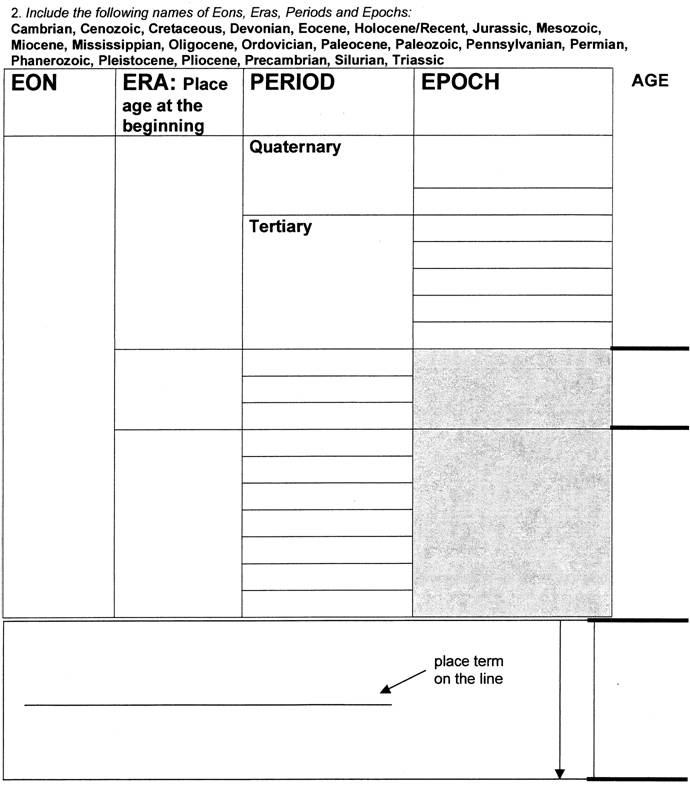
Part VI- Will consist of reconstructing the basic time blocks: Eons,
Eras, Periods and Epochs of
the
geologic timescale, by writing the proper names
and numeric ages of in proper
temporal sequence.
The Midterm will look
like this:
Part I.
Directions: Test and identify each of the ten unknown
mineral samples. 1) Circle the correct
physical
properties you observed and tested. 2) Name the mineral. There are 8 minerals
to
identify (Samples are lettered A through J).
Example:
Mineral
Sample A
a) Luster - Circle one: Metallic Nonmetallic
b) Mineral Hardness – Circle
one: Soft (1 to 3) Medium (3 ½ to 5 ½ )
Hard (6 and up)
c) Cleavage
- How many sets? - Circle
one: None
1 2 3
4
d) Other Tests: Streak: NA Yes No Acid Test: NA
Yes No Magnetic:
NA Yes
No
e) Name of the Mineral ______________________________
Part II. Rock Description, Analysis and
Identification
Directions:
Observe, test, analyze, and identify the 18 numbered unknown rock samples.
1) Circle one of the six possible italicized types
of rock textures/fabrics.
2) Circle ALL mineral and other component
choices identifiable in the rock.
Note: you must circle at least one
composition item
3) Write down the specific rock name of the
rock sample.
Example:
Rock Sample #1
a) Textural/Fabric
Igneous =
Plutonic Volcanic
Sedimentary =
Detrital (Bio)chemical
Metamorphic =
Foliated Nonfoliated
b) Composition
Amphibole Biotite
Calcite Carbon Clay Feldspar Fossils Garnet
Glass Gypsum Muscovite
Olivine Pyroxene Quartz Rock fragments
Salt Serpentine Tourmaline Vesicles None Observed
c) Name
of the rock sample = _______________________________
Part III. Stratigraphic Block Diagram
Relative Dating Analysis
Directions: Analyze the stratigraphic
block diagram handout. Do the following:
1) List the correct relative order of the labeled geologic events (letters A
to T);
and 2) List the
appropriate stratigraphic principle applied for each lettered event.
Example:
Relative Order of Events Principle(s) Applied Principle Abbreviations
_____ (youngest) ______________ Superposition = SP
_____ ______________ Cross-Cutting = CC
_____
______________ Unconformity
= UN
_____
______________
_____ ______________
_____
______________
_____
______________
_____ ______________
_____
______________
_____
______________
_____
______________
_____ ______________
_____
______________
_____
______________
_____
______________
_____
______________
_____
______________
_____
______________
_____ ______________
_____ (oldest) ______________
Questions:
1) Which type of unconformity
does “I” represent?
__________________________
2) Which type of unconformity
does “N” represent?
__________________________
3) Which type of unconformity
does “T” represent?
__________________________
4) What type of metamorphism has
Pluton “B” and Dike “R” imposed on the surrounding
sedimentary
country rock layers? Answer:
___________________________
5) Platystrophia
fossils were found in Sandstone Unit “A”. Elrathia
fossils were found in
Conglomerate Unit “L”. Based on the geologic time scale, what is
the possible age range of
the tilting, uplift, and erosional
event recorded in the Unconformity
“I” event as constrained
by the above
fossil ages? Use Figure 8.13 to answer this question.
Part IV. Stratigraphic Block Diagram
Absolute Dating Analysis
Directions: Calculate the correct absolute
dates for the igneous rock units using the appropriate
isotopic
analyses and the radiometric dating method. Use the info in your lab
book’s Figure 8.16
for finding the
proper half-life and decay rate for the specific parent-daughter isotopic pair. Note:
you must show your
calculations to earn full credit.
Example:
Isotopic Analyses of Granite Pluton
Unit “B”: The granite intrusion “B” in the
geologic block
diagram contains pristine zircon
crystals that were processed and analyzed for Uranium-235 and
Lead-207
content. The laboratory analyses of the samples
yielded the following U-235 / Pb-207
ratio:
Parent U-235 =
50.0% Daughter Pb-207 = 50.0%
1) Number of half lives
elapsed: _______
2) Calculated age of Granite
Intrusion “B” =
_______________ million years old
Do
Your Calculations Here:
Part V. Stratigraphic Analysis with
the Absolute Dating Information:
Directions: Using the numeric dates of the igneous units that you determined in
Section IV above,
answer the following questions
concerning the timing of geologic events in the geologic column
diagram.
Example:
Questions:
1)
Based on your calculated radiometric age results above, what is the tightest
possible age
range for the uplift and erosional surface event
recorded in unconformity
“N-T-N” ?
Answer: ____________to___________ million years old
2)
Based on your calculated radiometric age results above, what is the tightest
possible age
range for Limestone
Unit G?
Answer: ___________to____________ million years old
3) Which of the
absolute dated igneous rock units, Granite Pluton “B”, Basalt
Dike Unit “R”,
or Andesite Lava
Flow Unit “O” does the BEST job at constraining the minimum possible
age of Sandstone
Unit “K”? Explain why you chose your answer.
Circle one: Pluton “B” Dike “R” Lava Flow “O”
WHY? Explain Below
4) Phacops trillobite fossil were found in Rock Unit
“K”. Using BOTH the
fossil
ages
(found in Figure 8.13 in your lab manual) combined with the absolute
ages of the
igneous rocks
(calculated in Part IV), what is the BEST possible resolved age range for the
uplift and
erosional surface event recorded in unconformity “N-T-N”? Explain why you
chose your answer.
WHY? Explain Below:
Part VI. Geological Timescale
Directions: 1) Fill in all the spaces with the
appropriate timescale names found in the supplied word list.
2) ) Write down the appropriate ages at the appropriate
place for the following: 1) Beginning of
Earth time,
2) Beginning of the Paleozoic
Era, 3) Beginning of the Mesozoic Era, and 4) Beginning of the Cenozoic
Era.
Big Note: You CANNOT
use your lab manual or other notes to complete Part VI of the exam.