
Geology
101 Syllabus Spring
2012 San Diego Miramar
College
General Geology Laboratory - Course # 64716
3
Laboratory Hours, 1 Unit Letter
Grade, Student may petition for Credit/No Credit
Prerequisites Advisory: Completion
of GEOL 100 and ENGL 056, with a grade of "C" or better, or equivalent,
or Assessment Skill Level R5.
Meeting Time/Place: January 25 to May 16
- Wednesdays
6:30 pm – 9:45 pm -- Room S5111
Instructor:
R. Ray Rector
Contact:
phone# -760-942-9201, e-mail – geoprof@terrasonics.com
Office Hours:
Wednesdays 5:00 pm to 6:30 pm in Room S5111
Classroom Web site: http://www.terrasonics.com/ Click the “
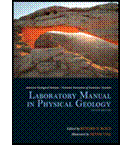
Required Text: Laboratory Manual
in Physical Geology - 8th or 9th Edition
Editors:
AGI and NAGT; 8th Edition: ISBN10: 0136007716; 9th Edition: ISBN10: 0321689577
Course Description: This laboratory course covers mineral and rock
identification, landforms, topographic/geologic map interpretation, and
geologic structures. The course is designed to supplement Geology 100 with
laboratory experience. (FT). Associate Degree Credit
& transfer to CSU and/or private colleges and universities. UC Transfer Course List. CAN GEOL 2 = GEOL 100 + GEOL 101
(City,
Student Learning Objectives: Upon completion of this course, students should be
able to:
1) Appreciate the methods and limitations of scientific
investigations of the Earth;
2) Distinguish
between science and pseudo science;
3) Identify, name, and classify the most common minerals and rock
types (Learning Outcome #1)
4) Apply stratigraphic principles to determine the age sequence of a
set of rocks layers (Learning Outcome #2);
5) Read and interpret a topographic map for point location, point-to-point
direction, topographic relief, and slope, including recognizing topographic
features such as peaks, basins, ridges and valleys (Learning Outcome #3);
6) Describe and classify the various types of folds and faults, and
explain their origin in terms of crustal forces and plate tectonic processes(Learning Outcome #4);
7) Locate, describe and classify the global-scale crustal features
of Earth, and explain the origin of those structures in terms of plate tectonic
principles and processes;
8) List and describe the major types of geologic hazards, and
explain both their origin and means of hazard mitigation.
Student Learning Outcomes: Upon completion of this course, students should be
able to:
1) Survey of Rocks and Minerals: Correctly
classify a set of twelve hand-specimen rocks into the 3 major rock groups and
correctly identify the most abundant mineral in each sample.
2) Geologic Time Literacy: Determine the proper age sequence of a
set of ten rock formations and two faults within a geologic cross section
diagram, using Steno's principles of stratigraphy;
3) Topographic
Maps and Spatial Literacy: Correctly interpret a
topographic profile for a line transect drawn across a topographic map,
including the location of ridges, peaks, and valleys;
4) Structural Geology & Geologic Map Literacy: Correctly interpret the ancient crustal stress regime (type and direction) that
produced a given sets of faults and/or folds illustrated on a geology
map.
Accommodation of Disability:
A student with a verified disability may be
entitled to appropriate academic accommodations, including the assistance of a
note-taker in the classroom, and/or extended time for taking exams. Students
with disabilities who may need academic accommodations should notify their
professor immediately. For further
information, please contact the Disabled Students Program and Services (DSPS)
Office.
Class Enrollment Notes:
It is the student’s
responsibility to add, drop, or withdraw from classes before the deadlines
stated in the class schedule. Petitions
to add, drop, or withdraw after the deadline will not be approved without
written proof of circumstances beyond the student’s control, which made her/him
unable to meet the deadline. Lack of money to pay fees is not considered an
extenuating circumstance. Students
anticipating difficultly in paying fees before the deadline should check with
the Financial Aid Office about sources of funds or other alternatives for which
they may be eligible. If you decide to
withdraw from this course, you are reminded to do so before the 3rd of February (last day to
withdraw without a “W”); and the 30th
of March (last day to withdraw with a “W”). If you fail to withdraw by 3/30/12 and
you stop participating in class, then a final grade must be assigned to you. It is the student’s
responsibility to drop all classes in which he/she is no longer participating
(for online classes). It is the student’s responsibility to drop all classes in
which he/she is no longer attending (for on campus classes). It is at the
instructor’s discretion to withdraw a student after the add/drop deadline
(include date) due to excessive absences (missing 3 or more labs). Students,
who remain enrolled in a class beyond the published withdrawal deadline, as
stated in the class schedule, will receive an evaluative letter grade in this
class.
Statement of Retention: Students, please discuss your plans to withdraw from class
with your instructors. They may have
options for you that may allow you to continue in class.
Instructor’s Attendance and enrollment Policy:
Attendance is critical to teaching and
learning in this lab class, and it is mandatory. You will most likely fall behind in acquiring
course content, vocabulary, concepts, and skills if you do not attend class
regularly. I realize that situations can
arise that are beyond your control, which could interfere with attending this
class Attendance is taken every class
meeting by means of a sign-up sheet that will be passed around at the beginning
of each class. You are required to
attend the entire scheduled lab meeting, unless I excuse you early. Note that
it is your responsibility to 1) sign in, and 2) attend the entire scheduled lab
meeting, in order to receive lab attendance credit for that class meeting.
It will be up to you for staying up with lab
assignments and exams. Make sure and
consult the schedule, lab manual, class notes, classroom website, and fellow
classmates about the material that was missed during absences. There is no make-up or rescheduling of either
labs or lab exams unless the student provides proof of some compelling reason
for the make-up. It is the student’s
responsibility to contact me to forewarn me of any problem in either, attending
the regular-scheduled labs and exams, or completing the lab write-ups by the
due date. Business, pleasure, or being
generally ill, is not a compelling reason - being horribly sick, or having a
death in the family is.
Classroom Behavior and Student Code of Conduct:
Students are expected to respect and obey
standards of student conduct while in class and on campus. The student Code of Conduct, disciplinary
procedure, and student due process (Policy 3100) can be found at the Office of
the Vice President of Student Services.
Charges of misconduct and disciplinary sanctions may be imposed upon
students who violate these standards of conduct or provisions of college
regulations. As your instructor, I have the following expectations of your
behavior in this class:
1) Promote a positive learning
environment by exhibiting mutual respect and consideration of
the feelings, ideas,
and contributions of others.
2) Demonstrate a genuine desire
to learn, interact, and improve.
3) Demonstrate respect for
furniture, tools, equipment, and supplies in the classroom.
4) Clean up after yourself.
5) No eating in class – drinks
are OK, but must be stored in sealable containers.
6) All cell phones, pagers, and
audio players must remain turned off, or in silent mode. Active use of a cell phone or audio player
in the classroom during class time is prohibited.
7) This class will be conducted
in accordance with the college code of student conduct and basic standards of
academic honesty. Cheating, plagiarism, or other forms of academic dishonesty
are totally unacceptable and will not be tolerated. Violations of standards of academic honesty
will be reported to the school dean for appropriate action. A full explanation of my plagiarism policy is
found on the classroom website.
Grading/Evaluation
I.
14
Laboratory Assignments – 30 points each
II.
Mid-term
and Final Exams - 120 points each
III.
Late
lab assignments are not accepted – no exceptions.
IV.
Missed
labs due to absence receive zero points.
No post-lab make-ups allowed.
V.
One of the 14 laboratory
assignment grades (lowest grade) will be thrown out.
VI.
Voluntary
field trip extra credit not to exceed 50 points
VII.
Total
points used to calculate grade = 630 points
VIII.
Grading Scale: 100% –
90% = 630 - 567 points = A
89%
-- 80% = 566 - 504 points = B
79%
-- 70% = 503 - 441 points = C
69% -- 55% = 440 – 347 points
= D
The following are required lab supplies (by second class meeting) that you will need for all labs during the semester: geology lab text manual (at bookstore or online), #2 pencils with erasers, calculator, and a clipboard (recommended) for field trips. Please, use only a pencil in lab!
Laboratory
Worksheets: Students need to make a
printed copy of each week’s lab worksheet, and bring that with you to the
lab. Worksheets are found at: http://www.terrasonics.com/index_miramar.html
II. During the Lab: A brief lecture about the lab by the instructor will help to explain some of the activities that you will complete in the lab. Additionally, make note of the following 6 points:
1) Be prepared by reading the lab and becoming familiar with it before we start.
2) Do not disrupt other lab groups by excessive off-topic talking, socializing, etc.
3) You may work with lab partners in groups of up to 3 or 4 (not any larger groups, please).
4) You must have your own lab notebook and worksheet, no sharing.
5) You may not split labs among lab partners and recombine the parts later. In other words, you must complete the entire lab as a group.
6) Please turn off your cell phone unless you are expecting an emergency.
III. At the End of the Lab: When your group has
completed the lab exercise, turn in your completed, properly COLLATED and
STAPLED lab WITH your written
reflection. Points will be deducted for being disruptive, coming to lab late, not being
prepared, or incomplete and/or unsatisfactory work.
Students should obtain
a 3-ring binder notebook to compile your laboratory coursework, which will
include the following work for each week’s lab:
1) Your completed lab worksheets
for that week’s exercise. (28 points possible)
2) A written summary/reflection
(120 word minimum) of the lab activity,
explaining its purpose, the methods used, the results obtained, and a brief
personal reflection of what you enjoyed and learned about doing this lab (3 points possible). Answer the following
3-point question reflection set for EVERY single lab meeting, including
the fieldtrips:
1) What was the purpose of this lab? What did
you actually discover and learn during this lab?
2) What did you enjoy most about this lab?
Also, what was challenging or thought-provoking?
3) What are your constructive comments about
the design and execution of this lab?
What’s good? What’s bad? Also, how might it be make better?
Voluntary Weekend Field Trips
Five weekend field trips are tentatively planned for this semester. These
field trips are totally voluntary and earn you extra credit points! Check the
professor’s classroom web page for details.
1) Weekend field trip #1: Saturday, February
11 – Torrey Pines Beach, 9:00 am
2) Weekend field trip #2: Saturday, March 10 -
Blacks Beach, 9:00 am
3) Weekend field trip #3: Saturday, April 7 -
Moonlight Beach, 9:00 am
4) Weekend field trip #5: Saturday and Sunday,
April 28 & 29 – San Diego Backcountry
Note: This fieldtrip is an overnight camping trip in the desert.
5) Weekend field trip
#4: Sunday, May 7 – Birch Aquarium, 9:00 am
The
admission fee is $8 (with a student ID) for the Birch Aquarium.