Dates: Friday, December 10th @ 9:15 AM
Where: Meet at
Note: There are
fieldtrip guide maps and directions.
How to Get
There:
Directions:
|
|
Follow I-5 south to |
|
|
Take the |
|
|
Turn right (west) on Garnet; stay on Garnet all the way to |
|
|
Turn right (north) on |
|
|
Follow |
|
|
Once you've parked, walk down the hill, to |

For an in-depth
description of this beach and how top get there go to:
http://entertainment.signonsandiego.com/places/tourmaline-surfing-park/#
Self-Transportation:
Carpooling with your fellow
students is highly recommended.
Public
Transit:
Call San
Diego Transit at (619) 233-3004 for buses that serve this beach.
Parking:
A 30 space parking lot (3 disabled
spaces) can be found at
How Long
Will the Trip Last?: The trip will probably take
about 2 to 3 hours to complete.
Cancellation
due to Weather: The field
trip will be cancelled if it rains.
Purpose: To
familiarize students with the coastal geology of San Diego County: 1) better understand the concepts
concerning shoreline processes and geomorphology, 2) tectonics and recent
faulting, 3) depositional and erosional environments and local stratigraphy, and 4) the geologic
history of San Diego County.
Lab
Activities: Observe, Study, Measure, and Discuss the nature of
deposition and erosion of the beaches and bluffs, coastal geology, and recent
faulting within coastal
Field
Assignment: Students
will be required to complete a field trip handout, which includes answering
fill-in questions, and writing a short reflection on the field trip
experience.
The worksheet that we will
complete during this field excursion can be found at this link:
http://www.terrasonics.com/geolab_fieldtrip2_worksheet.htm
What to
Bring: Students
should bring a clipboard, notebook, writing tools, a ruler, camera, water, sunscreen,
and a surfed-out attitude.
What to
Wear: Loose,
comfortable clothes (T-shirt and shorts is good) along with a hat and
sweatshirt or windbreaker. Beach weather may could
range from sunny and warm to overcast and cool. So it is a good idea to be prepared
either way.
How to
Prepare for Fieldwork: Carefully study the information and figures found below before the
day of the fieldtrip:
Geologic Background of
If we travel
approximately 10 miles west of campus to the coast - north of
Geology Map of Area
|
|
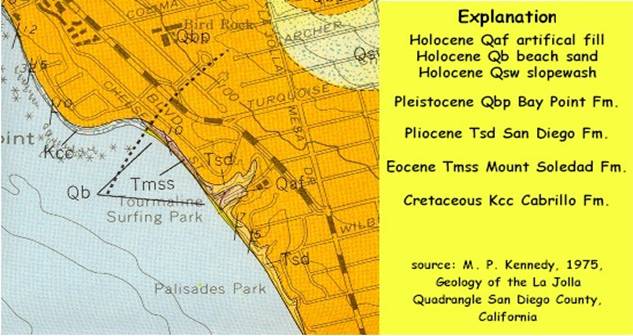
Stratigraphic Column
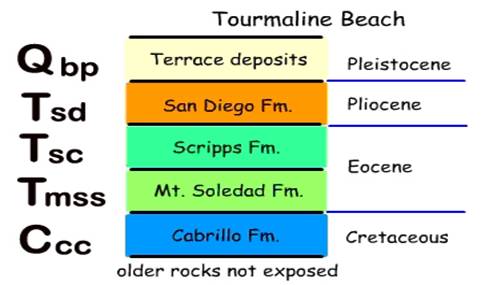
The oldest rocks exposed
along the cliffs at
Cenozoic rocks exposed at
Overlying these Eocene
rocks are sedimentary rocks consisting of conglomerate and fine grained
sandstone called the San Diego Formation. The conglomerate has cobble sized
clasts and occurs at the base of the formation. The remainder of the formation
consists of sandstone. These rocks are not well cemented and tend to crumble
easily. They were formed in intertidal and beach environments. Fossils are
abundant in some layers of the formation, and indicate an age of Quaternary
(Pliocene).
The youngest rocks at
Richard Miller - SDSU -
Author