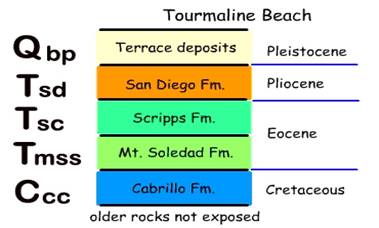
Stratigraphic Column
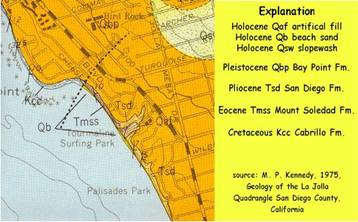
Tourmaline Beach - Meosozic Time
The oldest rocks exposed along
the cliffs at Tourmaline Beach are to the north end of the beach at False
Point. These are sedimentary rocks that are mostly conglomerate and some very
coarse grained sandstone called the Cabrillo Formation. These rocks were
probably deposited in shallow marine to beach conditions. Although few fossils
have been found in the Cabrillo, fossils in associated formations provide
evidence of a Cretaceous age, but somewhat younger (perhaps 40 million years
younger) than that of the Santiago Peak Formation exposed a bit further inland.
Tourmaline Beach - Cenozoic
Time
Cenozoic rocks exposed at
Tourmaline Beach are sedimentary rocks that include conglomerate, sandstone,
and mudrock. The oldest of these are pebble to cobble
conglomerate and sandstone of the Mt. Soledad Formation. These rocks were
deposited as channel fill in beach environments. Conformably above the Mt.
Soledad Formation are mudstone and siltstone of the Scripps Formation. These
rocks were deposited in environments ranging from tidal flat to submarine fan.
Fossils in these and laterally equivalent formations in other local areas
indicate that both formations are of Early Cenozoic age (Eocene), but are
slightly older than those at SDSU.
Overlying these Eocene
rocks are sedimentary rocks consisting of conglomerate and fine grained
sandstone called the San Diego Formation. The conglomerate has cobble sized clasts and occurs at the base of the formation. The
remainder of the formation consists of sandstone. These rocks are not well
cemented and tend to crumble easily. They were formed in intertidal and beach
environments. Fossils are abundant in some layers of the formation, and
indicate an age of Quaternary (Pliocene).
The youngest rocks at
Tourmaline Beach are terrace deposits that are probably of Pleistocene age.
They consist of mud, sand, pebbles and cobbles that are weakly cemented
together and tend to erode easily. Not a great place to build a house! The stratigraphic relationships of these rocks are illustrated
below.
Richard Miller - SDSU - Author
I. Lower
Section stops: The Rocks at PB Point:
Here at the point, we will observe the Cabrillo Formation and its overlying
neighbor, the Mt Soledad Formation.
The rock unit exposed in the wave-cut platform belongs to the Cabrillo
Formation (lowest formation), whereas the similar looking Mt Soledad is exposed
in the cliff. Cabrillo Formation Fm is late Mesozoic (72 million years)
and Mt Soledad Fm. early Tertiary (52 million years).
A. Observations and Analysis of the Cabrillo Formation:
1)
What specific rock type(s) make
up the Cabrillo Formation? (Hint: it’s detrital sedimentary)
Rock type(s):_______________________________________________________________.
2)
Name the three major rock types
that make up the cobbles in the Cabrillo Formation.
_______________, _________________, and ____________________
3) What type of material makes up the matrix between
the large clasts? ____________________
4) Estimate rock fragment size and shape in the Cabrillo Formation
(pebble and cobble clasts)
Clast
Size Range:
_____________ (centimeters) Clast Shape
Range: ____________________
5) Is the Cabrillo Fm rock a clast-
or matrix-supported conglomerate? ______________________
6) Is this sedimentary deposit poorly sorted or well sorted (rock fragments exhibit a wide range of sizes? or
are the rock fragments are all about the same size)?
________________________
8) Are the rock cobbles younger, older or the same age
as the Cabrillo Fm? Explain.
9) What two sets of evidence within the Cabrillo Formation indicates that
the sediment in this formation was a) moved
far from its source, and b) deposited
in a high energy
environment?
Answer: ____________________ and ______________________
10) What's the most likely depositional
environment for the Cabrillo Fm? __________________
11) LIST, SKETCH, and LABEL the Cabrillo
Formation on your Stratigraphic Column Worksheet.
B. Observations and Analysis of the Mt Soledad Formation:
1)
What specific rock type(s) make
up the Mt Soledad Formation? (Hint: it’s detrital sedimentary)
Rock type(s):_______________________________________________________________.
2)
Name the three major rock types
that make up the cobbles in the Mt Soledad Formation.
_______________, _________________, and ____________________
3) What type of material makes up the matrix between the
large clasts? ______________
4) Estimate rock fragment size and shape in the Mt Soledad Formation
(pebble and cobble clasts)
Clast
Size Range:
_____________ (centimeters) Clast Shape
Range: ____________________
5) Is the Mt Soledad Fm rock a clast-
or matrix-supported conglomerate? ___________________
6) What 2 sets of evidence in the Mt Soledad Fm indicates that the
sediments in this formation were also a) moved
far from its source, and b) deposited
in a high energy environment?
Answer: ____________________ and ______________________
7)
What evidence indicates that the Mt
Soledad Fm’s depositional setting was a river system?
Answer: ______________________________________________________
8) Compare the pebbles and cobbles that comprise the Mt Soledad Formation
with those that you observed in the underlying Cabrillo Formation. Are
there any differences or similarities? Make sure to mention:
a) Clast
size b) Clast rock type, c) Clast-
or Matrix-supported?
9) What type of unconformity bounds the Cabrillo and
Mt Soledad Formations?
_____________
10) The Mt Soledad
Formation contains a unique set of cobbles, called the “Poway”
clasts, which
have an exotic origin.
Rock Type Age
a) List the rock type and age for the “Poway” clasts. ___________________ ___________
b) Explain Where and How those clasts ended up in this
formation.
11) Why are there no “Poway”
clasts in the Cabrillo Formation?
12) LIST, SKETCH, and LABEL Mt Soledad
Formation on your Stratigraphic Column Worksheet.
II. Middle Section Stops - Northern Tourmaline Beach:
Here we
observe the Scripps Formation overlying the Cabrillo Formation. Note that the entire section of rocks at Tourmaline Beach are tilted (dipping) to the south.
This tilting is due to the growth of Mt.
Soledad a few miles to
the northeast. Mt.
Soledad is being pushed
up along a compressional bend in the Rose Canyon Fault Zone.
Therefore, as we head south we will be walking “up-section” through the whole
sequence, where the Cabrillo Formation will eventually pass under the beach,
giving way to the overlying Scripps Fm.
Much of the section south becomes completely Scripps Formation – the
thickest unit. The Scripps Formation is Eocene age (approx. 46 million years old) and
formed in the middle to lower sections of a deep sea submarine canyon.
A. Observations and Analysis of the Scripps
Formation:
1) Note the
contact between the Mt Soledad Fm and the Scripps Fm. Briefly describe this
contact. Is this contact considered an
unconformity? If so, which type?
2) There is a fault that cuts and
offsets the Mt Soledad and Scripps Formations here. Closely observe the characteristics of this
fault. Make observations and take
measurements of the faults: a)
Strike and dip, b) Apparent offset
direction and amount; c) Slickensides?
Fault
Strike and Dip:
_________________ Offset Motion: Hanging Wall moved Up? Or Down?
What type is fault is it? ____________
What type of stress caused it?
______________
3)
What specific rock type(s) make
up the Scripps Formation? ___________________________.
4) Is this sedimentary deposit poorly sorted or well sorted ((rock fragments exhibit a wide range of sizes? or
are the rock fragments are all about the same size)?
________________________
5) What 2 sets of evidence in the Scripps Fm indicates
that the sediments in this formation were deposited in a submarine canyon environment?
Answer: _________________________
and ____________________________
6) Estimate the dip angle (tilt angle with respect to the horizontal) of the Scripps Formation. Are these rocks dipping (tilted downward)
toward the north or south?
Dip angle: ___________
7) As you
continue walking north along the base of the sea cliff, notice how “messed up” (folded,
swirled, etc.) the Scripps Formation is in some spots. These irregular swirls
are the result of underwater mass movement events (slides, slumps, etc.) that
occurred in this rock unit as it was being formed. Did this deformation occur when the Scripps
Formation was still soft sediment or after it hardened into a rock? Briefly
explain your answer.
8)
Now, walk down the beach along the base of the sea cliff. Keep
walking south until you notice a series of criss-crossing
fractures filled with a very soft, clear mineral. This mineral was precipitated
inside cracks in the rock by groundwater. What mineral is this? Hint:
it’s very soft and it doesn’t fizz in hydrochloric acid.
Answer:
_________________
9) LIST, SKETCH, and LABEL the Scripps Formation on your
Stratigraphic Column Worksheet.
III. Upper
Section Stops - Southern End of Tourmaline Beach:
A.Observations and Analysis
of the San Diego
Formation:
Walking south along
the beach, before you reach the parking lot, high up on the sea cliff is a
layer of conglomerate that overlies the Scripps Formation. This rock layer forms the base of the
Pliocene San Diego Formation (less
than 3 million years old). Observe the south-dipping contact between the
underlying Eocene Scripps Formation and the overlying Pliocene San Diego
Formation.
1) What
type of unconformity bounds the Scripps and San Diego Formations? ______________
2) What span of time does this unconformity comprise? _____________________
3)
What specific rock type(s) make
up the San Diego
Formation? ________________________.
4) Is this sedimentary deposit poorly sorted or well sorted ((rock fragments exhibit a wide range of sizes? or are
the rock fragments are all about the same size)?
________________________
5)
Further down the beach, south of the parking lot, you’ll notice that the
sandstone exposed in the sea cliff contains numerous fossils within the San
Diego Formation.
Identify and Record all the different fossils you observe. Note: at a minimum, you should be able to find at least two different
types of fossils. Look carefully!
You’ll see ‘em!
Fossil #1: _______________ Fossil #2: _______________ Fossil
#3: ______________
6) What 2 sets of evidence in the San Diego Fm indicates that the
sediments in this formation were deposited in a rather quiet shallow offshore shelf environment ?
Answer: _________________________
and ____________________________
7) LIST, SKETCH, & LABEL the San Diego Formation on your Stratigraphic
Column Worksheet.
IV. Post Trip Reflection
Each student must write a lab reflection
(minimum of 120 words in length) about your experience in doing the exercises
in the field lab today. Include the
following: 1) The central purpose of this fieldtrip; 2) What was the most
important thing that you learned from doing this excursion? 3) What was the
most interesting aspect of the lab? 4) What was the biggest problem or
challenge that you encountered while doing this lab? 5) Provide some
constructive criticism of the fieldtrip design.
Hand write (if you’re neat) or type.
1) Purpose of lab:
_________________________________________________________________
_______________________________________________________________________________
2) What actually learned?
__________________________________________________________
_______________________________________________________________________________
3) Most interesting aspect(s)?
______________________________________________________
_______________________________________________________________________________
4) Most difficult or challenging aspect(s)? _____________________________________________
_______________________________________________________________________________
5) Thoughts on trip design and execution
______________________________________________
_______________________________________________________________________________
_______________________________________________________________________________